
I struggled to get to work by 9 this week because I was up coding until 2am several nights in a row, like I was a college kid again. The rough mornings weren’t a problem, though. In fact, I’ve been feeling quite good about myself, and more than once I caught myself laughing giddily at what I was making. My latest creation is ridiculous and I love it. But it did make me stop and think: what the heck am I doing with my time?
My friend Brad Nelson and I were texting recently, right after he gave a meetup talk to a room of about ten people, and the conversation drifted the way it does between two people who spend a lot of their free time on things that look suspiciously like work. Brad wrote a book called I Think, Therefore I Know, speaks at conferences, runs the Agile Detroit meetup, and co-hosts the Agile for Agilists podcast. I write books, build software, and teach a college course. Nobody at our day jobs asked either of us to do any of it, and neither of us can point to a promotion, a raise, or a flood of new readers and say “there, that’s what all those evenings bought me.”
Brad put the question plainly. There are people who work eight to four and that’s it. They don’t have a side gig, they don’t take classes, they don’t build anything work related, and plenty of them are doing fine. So what exactly are the two of us getting for all the extra effort?
My first answer was the one I’ve been telling myself for years, which is that everything extra you do gives you an unfair advantage, and that the harder you work, the luckier you get. Brad didn’t let me get away with that, and I think he was right not to. He pointed out that luck and hard work can both be true at once, but that people like the two of us were handed a long list of advantages before we ever put in an extra hour, and that we don’t live in a meritocracy where effort reliably converts into reward. I agreed with him then and I still do. I’d even add that having free evenings to spend on side projects is part of that same good fortune, because a lot of people spend those hours at a second job or taking care of someone they love.
How do you keep score?
But if extra effort doesn’t guarantee a payoff, why bother? This is where the conversation got interesting to me, because Brad and I are doing roughly the same thing and having very different experiences of it, and I think the difference comes down to how each of us keeps score.
Brad asked me whether I ever sit back and think, “wow, I’ve done so many awesome things,” or whether I’m more like him, where the things he’s made feel cool but not quite awesome because they haven’t changed his quality of life. He told me he has a sticky note on his monitor that says “What is enough?” I’ve been thinking about that sticky note ever since.
My answer in the moment was that my projects make me happy and that’s why I do them. That’s true, but it’s only half the story, and I’d rather be upfront about the other half because I actually run two kinds of side projects and I treat them very differently.
Two kinds of side projects
The first kind is the long game. I’m working on a retirement plan where I can work as much or as little as I want and still afford to travel and take vacations with my family. The pieces are no secret: two books, a software product called Measure the Mindset that builds on the content of both books to help agile teams and leaders assess themselves, and enough credibility from all of it that I can consult as a subject matter expert when I feel like it. None of this is paying off yet. Books sell slowly, the software isn’t public, and the scoreboard for this kind of work lags by years.
On the days when the lack of traction gets to me, I go back to my vision board, which is itself a little app I built with Claude. It keeps my long-term plans in front of me and helps me cut myself some slack when yet another week goes by without any book sales. It also reminds me to celebrate the wins that never show up in a sales report: a blog post that really resonated with someone, another email asking when the Kindle version will be available, a tough problem finally solved in my software project. Mostly it reminds me that I’m judging a ten-year plan by this week’s numbers.
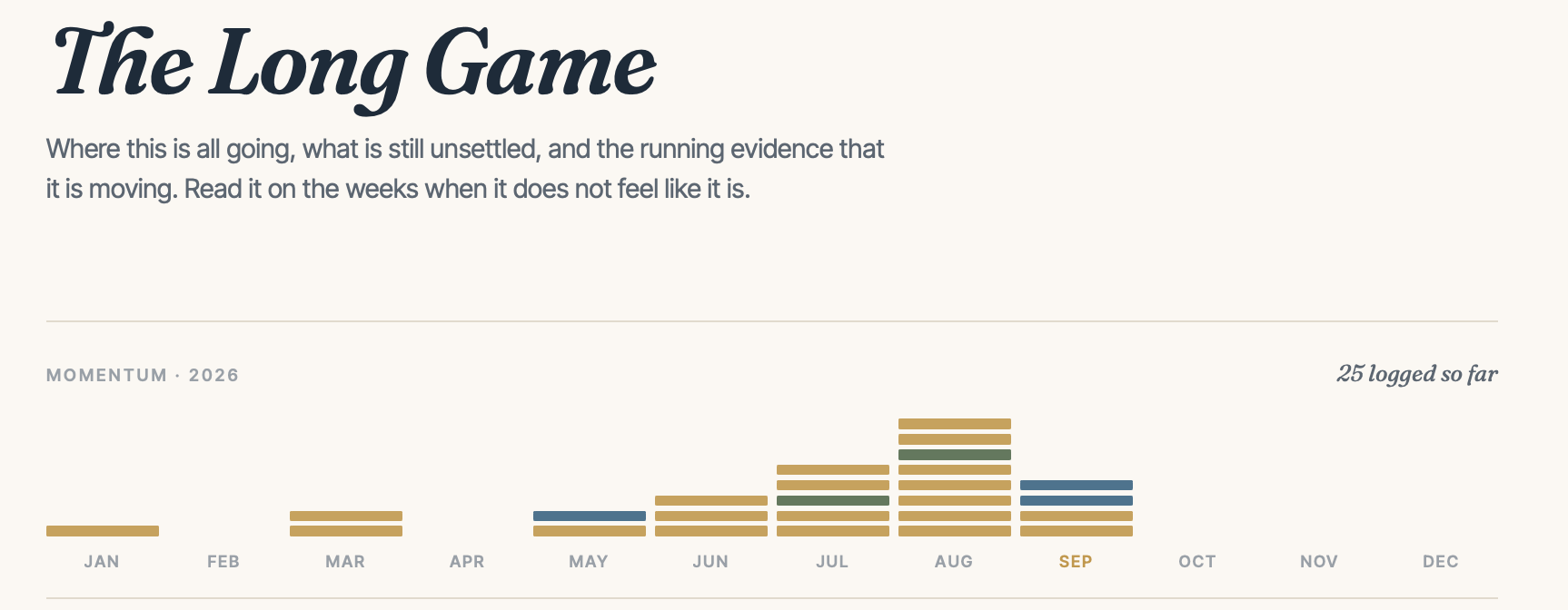
That brings me back to the 2am coding sessions. My second kind of side project fills what my vision board calls the personal joy tank, the one nothing else refills, and I built two of them in one week.
The first is heavyrotation.tv, the ridiculous creation I mentioned. You press the red button on a remote control and 80s music videos play back to back the way MTV used to, and you can try to guess the release year before the song ends. I know I’m not going to get rich from an MTV clone, but man was it fun to build. And I’m using it every day.

The second is walkablecitytours.com, which I made because I’m headed to Québec City and Montreal this month and I wanted a better walking guide than anything I could find. It’s got about sixty interesting places around town, each with a line on why you’d bother to go see it, sorted by how many minutes away they are on foot from wherever I’m standing, and it even takes into account when you have to go up stairs or walk uphill. I like to plan in advance before going on trips, then I completely abandon the plan and explore at will. This app will be amazing for me (and how I travel) as I maximize my two days in Québec City.


Not only am I already using both of them, but I also learned a lot about building whole products with AI tools along the way, and I stayed sharp as a technologist in a year when that seems to matter. The reward on those projects was collected the day they worked.
I realize those two motives can sound contradictory, as if I’m claiming to do it all for love while quietly running a business plan. I think they hold each other up. The long game is bearable because the joy tank projects pay me back immediately, and the joy tank projects keep building the skills the long game depends on. They also share one rule, which is that I only build things I would want to exist even if nobody else ever showed up. I wrote the book I wished I’d had as a coach. I built the assessment tool I wanted to use with my own teams. That means the floor on any of these efforts is never zero, and anything that comes later is upside on a bet I’ve already won.
The outcomes you control
There’s an irony here that I can’t ignore, given what I do for a living. I spend my days telling teams to measure outcomes instead of outputs, and Brad is doing exactly that with his writing and speaking. The trouble is that the outcomes he’s measuring belong to other people: an algorithm, a review committee, a conference organizer who never writes back. I think the trick is to make sure at least some of the outcomes on your scoreboard are ones you control. Did I learn something? Am I using the thing I made? Did I enjoy making it? Do I have a better story to tell than I did a month ago?
When Brad read this post, he pointed out something I had missed, which is that he has a joy tank too. He writes fiction, builds his own web apps, and has a list of house projects waiting, and everyone in his family has something they would love his help with. The frustration he was describing to me is that every hour he gives to the work-related writing and speaking is an hour taken from all of that, which means the long game has to pay off well enough to be worth what it costs him at home. I think that’s a better version of the sticky note question than the one I started with. A scoreboard needs a cost column, and what goes in it is everything else you would have done with the evening, which for me this week was mostly sleep.
Keeping score this way has also made it easier to be choosy. Brad and I both admitted that a local talk to a room of ten people has become a lot of energy for very little return. I’m not giving up speaking, though. I’m keeping the kind that takes me somewhere I’d want to go anyway, because then being there is the reward whether or not the talk changes anything. Being restless doesn’t mean saying yes to everything.
And I don’t want any of this to read as a judgment of the people who close the laptop at four and go coach their kid’s soccer team. They’ve answered the question on Brad’s sticky note differently than I have, and quite possibly more wisely. I’m restless and I can’t seem to do the bare minimum, which I think says more about my temperament than my virtue.
So I’m curious where you land. Do you spend time outside of work on things meant to benefit you down the road, and if so, how do you keep score? And if you’ve decided not to, what did you decide was enough?
Where this connects to the book
This post is mostly about my evenings, but two ideas underneath it come straight out of Assembled. Aligned. Adaptive. The first is outcomes over outputs, which sits in the strategy part of the book and is the reason I started wondering whose outcomes Brad and I were really measuring. The second is Peter Senge’s discipline of personal mastery, the commitment to keep learning that has nothing to do with your current role, which shows up in the chapter on the learning organization. Senge’s point is that an organization cannot learn faster than the people in it, and I think that’s the best argument I know for leaders to be glad when their people have a side project or two.
The longer version of both ideas is in the book, here.