Get an autographed copy — $25, and the shipping's on me.
The book is available now. You can grab it on Amazon at the $34.75 list price — or order a copy signed by hand and shipped straight to you for less.
Autographed. Free shipping. About $10 under list.
Signed and shipped by hand — please allow about a week or two. Secure checkout via Stripe; U.S. shipping for now (email me for international).
Want it faster, or shipping outside the U.S.?
Buy on Amazon — $34.75 →Most transformations don't fail for lack of ambition. They fail because the organization was never built to sustain the change.
You've done the work. New strategy, new structure, teams trained in agile. Each was a real improvement — and yet the transformation won't take.
Real progress stalls, and the culture feels too stubborn to move. The talented people aren't the problem. You changed the parts one at a time and never the way they work together.
Brian Link distills the best thinking of fifty of the greatest minds in business — from Richard Rumelt and John Doerr to Amy Edmondson and Marty Cagan — into one integrated system: the Adaptive Organization Operating Model. It defines the five components every company needs for true business agility, and the leadership behaviors that hold them together.
The constraint is the system. The only person who can redesign the system is a leader.
This book is for leaders tired of applying point solutions to systemic problems. It gives you a shared language for the whole system, a map to diagnose where yours is breaking down, and a practical path to building an organization that adapts — one team and one changed leadership habit at a time.
None of the five layers will surprise you — you've heard all of them. Two things, though, have rarely been done. The first is fitting them into a single operating model instead of five separate initiatives that never add up. The second matters more.
For years the coaching advice has been the same: build the environment where teams can succeed. It was always right — and yet it was never enough, because no one described what that environment actually was. That environment is the operating model, and it gets built the slow way: through changes in behavior.
The behaviors that make agile real on a team have been taught for years; that part is well understood. What has never been spelled out is the behavior above the team — the leaders who own delivery, and the leaders above them who reinforce it. Most are still running the old management playbook inside the new system, because no one ever told them how to change.
This book tells them — what to start doing, what to stop, and what to model — until the environment that supports agility is built.
The model isn't a methodology. It's an operating model — five interdependent layers that, when aligned, create the conditions for true business agility.
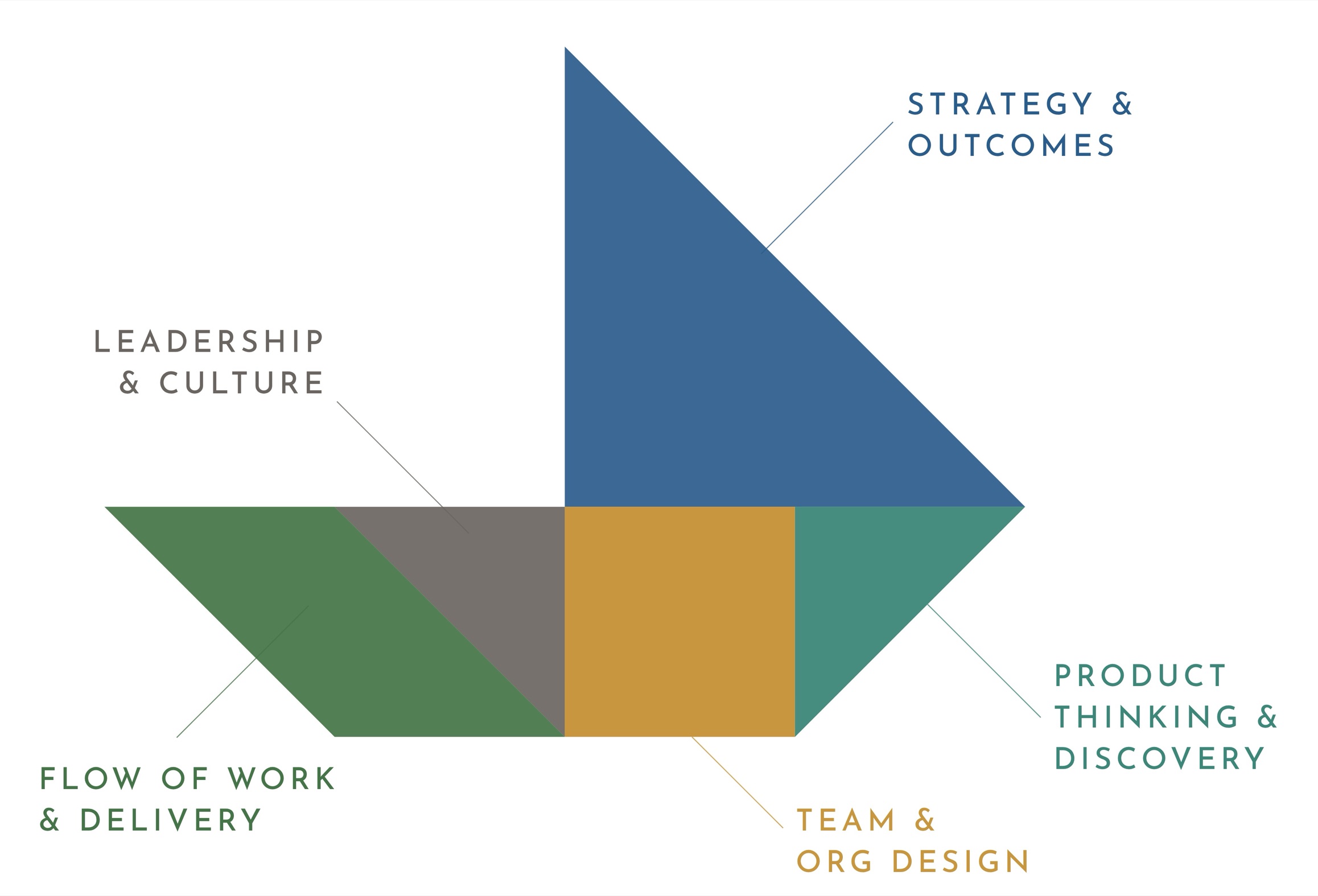
Pull one out and the system bends back to its old shape. Strategy without product thinking executes the wrong solutions with confidence — and none of it holds if leaders keep operating in command-and-control, because the whole system runs on trust, ownership, and learning at every level.
Each chapter draws from the thinkers who shaped that conversation — synthesized, not surveyed. A final reference summary brings the whole model into one place.
Brian Link has spent two decades helping organizations close the gap between strategy and execution. He coaches executives and leadership teams at scale, and writes and speaks on business agility, product thinking, and organizational design.
This is his second book. His first focused on coaching practice. This one is for the leaders those coaches are trying to reach — the people who own the system.
This is the integrated operating model every leader must build to create an adaptive organization — one wired for change, no matter what the future brings.